

Key Takeaways
- A token is roughly three-quarters of a word — AI companies charge once for what you send in and once for what comes back out
- $5 per million tokens means about five dollars to read 1,500 pages, or roughly 3,700 typical customer emails
- Flat $20/month plans hide tokens until you hit a limit mid-task, feed in long documents, stack multiple tools, or the terms change
- Output tokens cost 5–6x more than input across every major model — writing pages back is what runs up a bill, not reading your documents
- Chinese open models can be 100x cheaper on output, but do not put patient records, client financials, or anything covered by privacy rules into them
What "$5 per million tokens" actually means for your business
Everyone quotes AI prices. Nobody explains them. Here's the translation.
Read this once and you will be able to look at any AI price for the rest of your life and know exactly what you are looking at.
First — what a token actually is
A token is a chunk of text. Roughly three quarters of a word. "Thank you for reaching out" is about six tokens.
AI companies charge by the token because that is how the machine reads and writes. It is like a phone company charging by the minute instead of by the call. And they charge you twice: once for what you send in, once for what comes back out.
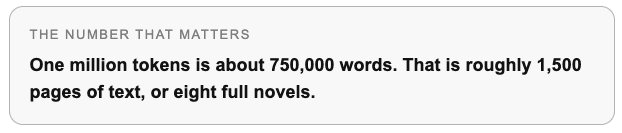
So when you see "$5 per million tokens," what it actually says is: five dollars to read 1,500 pages. In terms you would recognize instead: a typical customer email is around 200 words. One million tokens is roughly 3,700 emails. Reading all of them costs a few dollars. Writing a reply to one costs well under a penny.
When this actually shows up on your bill
If you pay a flat twenty dollars a month and use AI in your browser, you never see a token. So why does any of this matter?
Because flat pricing has edges, and you find them at the worst possible moment.
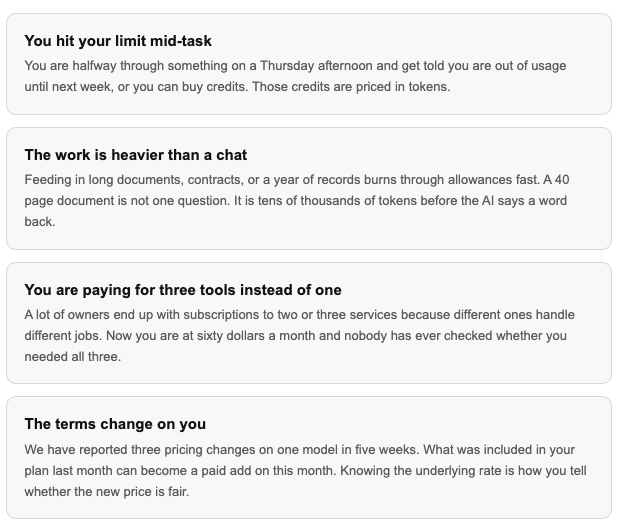
You hit your limit mid-task. You are halfway through something on a Thursday afternoon and get told you are out of usage until next week, or you can buy credits. Those credits are priced in tokens.
The work is heavier than a chat. Feeding in long documents, contracts, or a year of records burns through allowances fast. A 40-page document is not one question. It is tens of thousands of tokens before the AI says a word back.
You are paying for three tools instead of one. A lot of owners end up with subscriptions to two or three services because different ones handle different jobs. Now you are at sixty dollars a month and nobody has ever checked whether you needed all three.
The terms change on you. We have reported three pricing changes on one model in five weeks. What was included in your plan last month can become a paid add-on this month. Knowing the underlying rate is how you tell whether the new price is fair.
What the top models charge right now
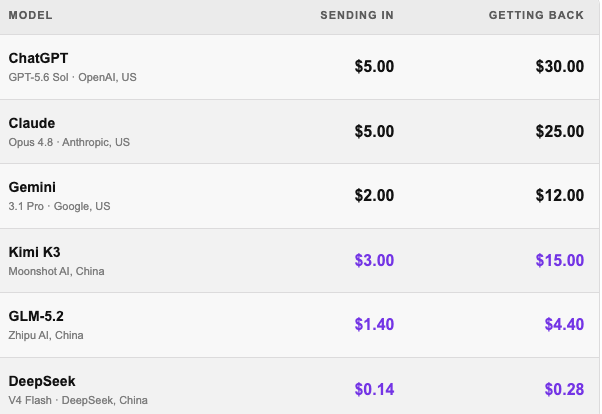
These are the flagship versions of each. Both columns are per million tokens. "Sending in" is what you give it. "Getting back" is what it writes for you.
| Model | Sending in | Getting back |
|---|---|---|
| ChatGPT (GPT-5.6 Sol · OpenAI, US) | $5.00 | $30.00 |
| Claude (Opus 4.8 · Anthropic, US) | $5.00 | $25.00 |
| Gemini (3.1 Pro · Google, US) | $2.00 | $12.00 |
| Kimi K3 (Moonshot AI, China) | $3.00 | $15.00 |
| GLM-5.2 (Zhipu AI, China) | $1.40 | $4.40 |
| DeepSeek (V4 Flash · DeepSeek, China) | $0.14 | $0.28 |
* Chinese models are the last three rows. Verified this week from published rates. These move constantly — three of these changed in the last month alone. Treat it as a snapshot, not a permanent reference.
Compare the top row to the bottom row. On what comes back out, DeepSeek is over one hundred times cheaper than ChatGPT's flagship. Not a little cheaper. Two orders of magnitude.
Kimi K3 is worth noting separately. At $3 and $15 it runs about half the price of ChatGPT's flagship, which is a real discount. But it is also five to fifty times more expensive than the other two Chinese models on this list. Moonshot priced it as a premium product, not a bargain. So "Chinese model" does not automatically mean "cheapest option" anymore — the gap between them is now bigger than the gap across the Pacific.
For more on why chasing the "best" model is the wrong question, see Which AI Model Should Your Business Use?.
Where to actually try these
One thing to clear up before you click. The chart above is what these companies charge per token for their strongest models. That is not what you pay in a browser. In a browser you get a flat monthly plan, and the free versions run lighter, older models than the ones listed above. Two different products from the same company.
We are not affiliated with any of these. The three you likely already know:
ChatGPT — chatgpt.com
Around $20 a month to reach the stronger models. There is a free version, but it runs a lighter one than what is in the chart.
Claude — claude.ai
Around $20 a month for the stronger models. Free version available with tighter limits.
Gemini — gemini.google.com
Similar monthly pricing, and worth checking your Google Workspace plan first since some tiers already include it.
Read this before the next three
The three below are Chinese models, and two things are true about them at the same time.
They are genuinely good and genuinely cheaper. On published benchmarks these models now compete with the best American systems, and on certain tasks they beat them outright. Two of the three cost a small fraction of what ChatGPT or Claude charge. That is not hype and it is not a fluke. Independent testing backs it up, which is exactly why the American companies have been cutting prices all summer.
They are also hosted in China and operate under Chinese law and data rules. Use them to ask general questions and see what they can do. Do not put patient records, client financials, signed contracts, employee information, or anything covered by privacy rules into them.
In fairness, that second warning applies to every free AI tool including the American ones. If you work in dental, medical, legal, or finance, you have obligations that no free chat window covers. Know what you are putting where.
DeepSeek — chat.deepseek.com
The cheapest by a wide margin and the easiest to try. Works in your browser and does not require an account to start.
GLM — chat.z.ai
Middle of the pack on price, one of the fastest of the group. Usable in a browser.
Kimi — kimi.com
The most capable of the three and priced accordingly. Fair warning: signup has reportedly required a Chinese phone number, so you may hit a wall.
The bottom line
The raw cost of AI has collapsed. Knowing what a token is turns every price you see from a mystery into a number you can judge.
— Aristotle Taylor, CEO & Co-Founder, Levron Labs
Not sure where your stack has a gap? Start with a free ops assessment.
P.S.
Look at the chart one more time and notice this: across every single model, what comes back out costs five to six times more than what you send in. That means feeding AI a lot of information is cheap. Having it write pages and pages back is what runs up a bill. If you ever find yourself burning through a usage limit faster than expected, that is almost always why.