
Key Takeaways
- Capability is converging and prices are falling — the "best model" answer expires before you can act on it
- Any competitor can buy the same model tomorrow; they cannot buy your twenty years of operational knowledge
- Advantage lives in proprietary data made machine-readable — not in which frontier model you subscribe to
- Invert the sequence: identify what only you know, structure that data, define the job, then point a cheap adequate model at it
- Only 17.7% of small businesses actually pay for AI tools — the market is not crowded
Which AI model should your business use?
A frontier model launched this week. Another launched last week. The one before that got pulled by the government. Here is why the question is wrong.
The short answer
It does not matter very much, and it matters less every month.
The gap between the most expensive AI model on earth and a much cheaper one that does most of the same work is closing fast enough that any answer here expires before you can act on it. Whichever model you pick, your competitor can buy the same one tomorrow for the same price.
What does not close is the gap between what your business knows and what everyone else knows. That is where the advantage actually lives, and almost nobody is looking at it.
The rest of this explains why, and what to do instead.
What happened in the last five weeks
This is not a hypothetical. Here is the actual timeline.
June 9. Anthropic released Fable 5, the most capable model it had ever shipped.
June 12. The US Commerce Department ordered it pulled. It went dark worldwide for 19 days.
July 1. It came back, with a billing change attached.
July 9. OpenAI released GPT-5.6. One developer reported paying $16 for work that had cost $63 on Fable 5.
July 13. Anthropic extended Fable 5's free access window for the second time in six days, announcing it after the previous deadline had already passed.
July 16. Moonshot AI, a Beijing lab, soft launched Kimi K3 after the announcement leaked two days early on its own developer platform. Early testers put it near Fable 5 and ahead of GPT-5.6 on some coding runs.
Five weeks. Three price changes on one tool, one government shutdown, and two new frontier class competitors.
Now widen the lens. A year ago, Chinese models accounted for roughly 11 percent of enterprise AI usage on major US developer platforms. A CNBC investigation this month put that figure between 30 and 46 percent.
Anyone who told you in June which model your business should standardize on was wrong by July.
Why "which model is best" expires
For about three years, the strategic question in AI was access. Who has the good model, what does it cost, can you even get it.
That question is closing. Not closed, but closing.
Capability is converging and prices are falling at the same time. A benchmark result now goes stale before a purchasing decision can clear. Frontier level intelligence is turning into a commodity input, like electricity or bandwidth. Something you buy, at a price that keeps dropping, from whichever vendor is cheapest this quarter.
Nobody builds a competitive advantage on having electricity.
This is the part that trips up most business owners: they treat the model choice as the strategy. It is not. It is the least durable decision in the entire stack, and it is the only one that gets easier every month whether you do anything or not.
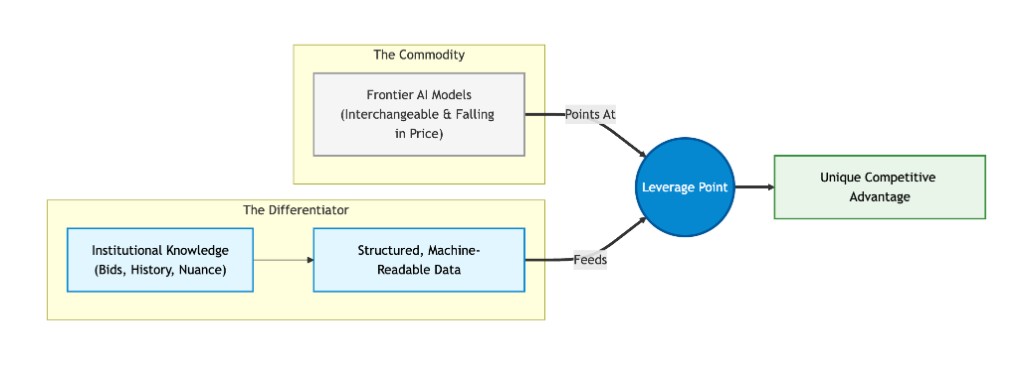
What actually creates advantage: the data you already have
When everyone has access to roughly the same intelligence at roughly the same price, the advantage moves to what you point it at.
Consider what a twenty year old contracting business actually owns. Not the trucks. Not the software subscriptions.
It owns a record of every bid it ever submitted and whether that bid won. It owns the pattern of which customers pay on time and which do not. It owns the knowledge of which jobs looked profitable on paper and turned into disasters on site. It owns the specific way its best estimator prices a job that the other three estimators cannot quite replicate.
That is two decades of accumulated, expensive, hard won institutional knowledge.
And in nearly every business we walk into, it lives in one of three places: a filing cabinet, a spreadsheet nobody has opened since March, or a person's head.
None of those places are readable by a machine.
That is the leverage point. Not the model. The proprietary reality of how your specific business works, made accessible to whatever intelligence you point at it this month.
Here is the asymmetry almost nobody prices correctly. Any competitor can subscribe to the same model you use, tomorrow, for twenty dollars. What they cannot do is subscribe to your twenty years.
The order of operations most businesses get backwards
The common sequence:
- Pick a tool
- Try to find something useful to do with it
- Get frustrated
- Conclude AI is overhyped
That sequence guarantees the outcome. It puts a commodity at the center of the strategy and treats the actual differentiator as an afterthought.
The inverted version:
- Identify what your business knows that nobody else knows
- Get that knowledge out of the filing cabinet and into a format a machine can read
- Define the job you want done against that knowledge
- Point whatever this month's cheapest adequate model is at it
Step four is the one everyone obsesses over. It is the least important. Steps one through three are the actual work, and they do not expire when a model gets pulled, repriced, or leapfrogged by a lab you had never heard of on Tuesday.
Run the counterfactual. If you had spent the last five weeks migrating workflows from Fable 5 to GPT-5.6 to whatever is next, you would be exactly where you started, minus five weeks. If you had spent those weeks getting twenty years of bid history into a structured, readable format, you would now own an asset that works in any model, including ones that do not exist yet.
One of those is a treadmill. The other compounds.
The part nobody wants to hear
This is more work than picking a tool.
Getting institutional knowledge out of people's heads and filing cabinets is slow, unglamorous, and impossible to finish in an afternoon. It does not photograph well. There is no launch announcement.
It is also the only part that is still worth anything in a year.
What to do this week
Not a five step framework. One question.
What does your business know that a competitor with an identical budget and identical software could not figure out in a year?
If you can answer that in a sentence, that answer is your leverage point. The only remaining question is whether it exists in a format a machine can read. Usually it does not.
If you cannot answer it, that is the more important finding, and it has nothing to do with AI.
For context on where most businesses actually sit: research from the JPMorgan Chase Institute found that only 17.7 percent of small businesses are actually paying for AI tools, well below the adoption figures that surveys report. The market is not crowded. Most people have not started.
If you want a second set of eyes on where your operation is losing time, we run a free audit. No pitch. We look at what your business does, find the gap between that and what your software thinks it does, and tell you what we find.
Frequently asked questions
What is Kimi K3? Kimi K3 is a frontier class AI model from Moonshot AI, a Beijing based lab. It soft launched on July 16, 2026, two days after the announcement leaked early on Moonshot's own developer platform. Reported specs describe roughly 2.5 trillion parameters and a one million token context window, though Moonshot has not published an official model card or benchmark table.
Is Kimi K3 open source? Not confirmed as of this writing. Moonshot released the earlier K2 family under a modified MIT license, which is why many people assume K3 will be open too. No license has been published. Treat the open weights assumption as an assumption.
Is Kimi K3 better than GPT-5.6 or Fable 5? Early independent testers report it performing near Fable 5 and ahead of GPT-5.6 on some coding tasks, with caveats about which benchmark harness was used. There is no official benchmark table. Anyone stating this confidently right now is going beyond the available evidence.
Which AI model is cheapest for a small business? This changes constantly, which is the point of this article. As of July 2026 there is real downward price pressure from GPT-5.6 and from Chinese models entering the market. The more useful question is not which is cheapest, but whether your setup lets you switch when the answer changes.
Do I need the most powerful AI model? Almost certainly not. Most business tasks do not require frontier level capability. If you can define what a passing result looks like for the job you want done, you can usually get it from a much cheaper model. Businesses default to the most powerful option because they never defined "good enough" and have no way to compare.
How do I keep my AI setup from breaking every time a model changes? Write down the job rather than the tool. Keep your prompts, business context, and examples of good output in documents you control instead of trapped inside one vendor's interface. Define what a passing result looks like so you can test alternatives quickly. Then try swapping models once before you are forced to, so you find the painful part on a calm Tuesday instead of the morning a price change lands.
The bottom line
The models will keep coming. One launched this week that most people had not heard of on Monday. Another will launch next month. Prices will keep falling, capabilities will keep converging, the leaderboard will keep reshuffling.
None of it will matter much to a business that never figured out what it uniquely knows.
Distribution is equalizing. What you point it at is not.
Aristotle Taylor is the CEO and co-founder of Levron Labs, where he and his team help small and medium sized businesses find the gap between what their operation actually does and what their software thinks it does.