
Key Takeaways
- OpenAI says ChatGPT advertising is running at a $1 billion annual pace — a projection from one month's ~$83M, not money already banked — and SMBs now make up a material share after the $50,000 minimum was dropped
- Google Pics launched inside Workspace at no extra cost on Business Standard and above — worth checking if you still need a separate Canva subscription
- Anthropic's new models embed an invisible watermark in generated text; detection is limited to regulators, newsrooms, and compliance teams for now
- Claude Fable 5.1 and GPT-6 Astra launched three days apart; Astra's 99.9% ARC-AGI-3 score used OpenAI's own test scaffolding, while the fair setup scored 62.7%
- The ads channel and the free Workspace tool change your week; the AGI headline does not
Week of August 31 – September 6, 2026
Four things happened in AI between August 31st and September 6th that are worth five minutes of your time as someone who runs a business.
One of them got enormous headlines. A different one actually changes something for you.
This is Last Week in AI — the signal, not the noise. Four stories operators need to understand, and what each one means for how you run your business.
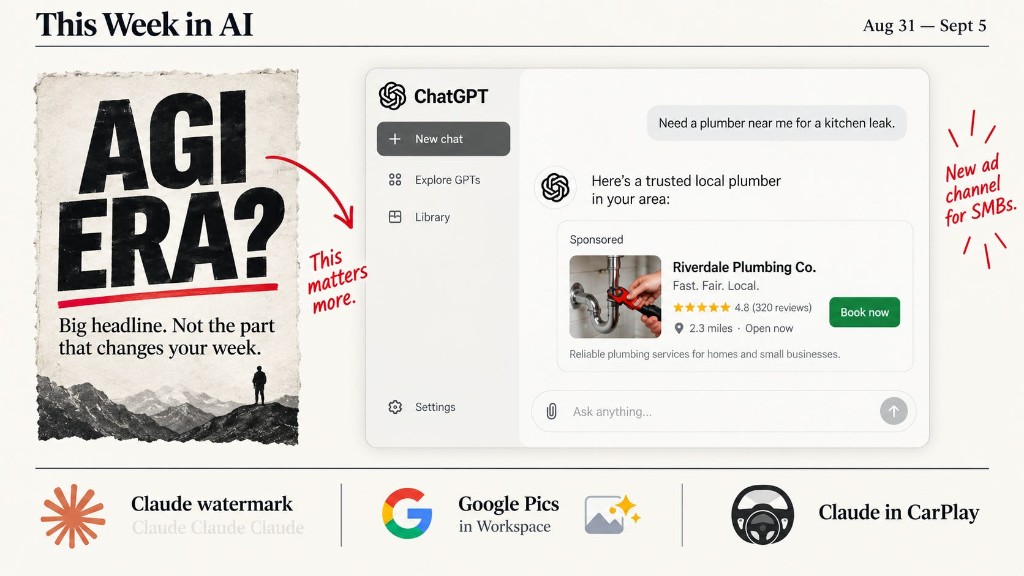
Story 1: ChatGPT became a place small businesses buy ads
OpenAI announced that advertising inside ChatGPT is now running at a $1 billion annual pace, reached in under 200 days.
Worth being precise about that number: it's a projection based on one month's revenue — roughly $83 million — multiplied by twelve. It's momentum, not money already banked.
But the part that matters to you is buried further down. OpenAI says small and medium-sized businesses now make up a "material share" of who's buying. Tens of thousands of advertisers are on it. And when they opened self-serve buying earlier this year, they dropped the $50,000 minimum spend that had kept it to large companies.
The same day, they opened direct ad buying across India, Europe, the Middle East, and North Africa. Ads run in more than 40 countries now.
Two details worth holding onto. Ads only appear for people on the free and cheaper plans — paid subscribers don't see them. And this isn't keyword advertising. The system reads the intent of a conversation to decide what's relevant, which means an ad can land while someone is still working out what they need, before they'd ever type anything into Google.
What it means for operators: a new advertising channel opened, and the buy-in bar is now low enough for a small business. Whether it's worth anything to you depends on whether your customers are the sort of people asking ChatGPT for recommendations. Some of them are. That number is growing.
Either way, it's the first genuinely new place to advertise in years, and unlike Google or Facebook it isn't crowded yet. (Same pressure we covered when AI knew your business existed but wouldn't recommend you — being findable in the places buyers already ask still matters.)
Story 2: Google put a Canva competitor inside Workspace at no extra charge
Google Pics went live September 1 — image creation and editing built directly into Google Workspace. You open it at pics.new, or select an image in Docs or Slides and edit it in place.
It covers a real slice of what small businesses open Canva for. Generating an image from a description. Editing one object without touching the rest of the picture. Changing or translating text inside an image without wrecking the layout. Cropping for social, print, or web. Upscaling to 2K or 4K.
The part that matters is the price. It's included at no extra cost on Business Standard, Business Plus, Enterprise Standard and Enterprise Plus — note that Business Starter is not on the list. It's on by default, and it's rolling out in waves through the end of September.
What it means for operators: if you pay for Google Workspace and you also pay for Canva, it's worth ten minutes to check whether you still need both. Some of you will — Canva does plenty Pics doesn't. But paying twice for the same job is the kind of thing that goes unnoticed for years.
Story 3: Claude started invisibly watermarking everything it writes
Quieter announcement, and it will touch more people than the headlines did.
Anthropic's new models, like the new Fable 5.1, now embed an invisible watermark in the text they produce. Nothing is added to the page — no hidden characters, no metadata. It works by subtly influencing which words the model picks when several would do equally well, leaving a statistical fingerprint. Copying and pasting doesn't remove it. Retyping it by hand doesn't either.
You can't see it. Neither can anyone else without a detection tool, and that tool is currently limited to regulators, law enforcement, newsrooms, fact-checkers, researchers, and companies with European compliance obligations. Anthropic says it carries nothing about you, your business, or your conversations.
This is driven by European law. It applies to models released after August 2nd, and these are the first ones. Older Claude models are expected to get it over the coming months.
Worth knowing: the mark is weak on short text, on code, and on drafts you've edited heavily, because it needs length and freedom of word choice to leave a pattern. If you're rewriting AI output before it goes anywhere, which most people are, there may not be much left to detect.
What it means for operators: the assumption that AI-written text is untraceable is starting to expire. Not a reason to stop using it. Most businesses use AI for drafts they then edit, which is normal and fine. But anything you publish word-for-word from a machine may be identifiable as such later, and it's better to know that now than to be told later. (Same practical rule as what AI is actually bad at: use it where you can spot a mistake and own the final version.)
Story 4: The two most advanced AI models (known to the public) ever built, three days apart
On Tuesday, Anthropic released Claude Fable 5.1, its most capable model.
On Thursday, OpenAI released GPT-6 Astra. Their president said it might eventually be seen as the arrival of artificial general intelligence. Axios ran the headline "Welcome to the AGI era."
The model is genuinely good. The claim around it deserves a closer look.
Start with what OpenAI's own CEO said days earlier. On a podcast the same week, Sam Altman was asked about the term AGI. His answer: "At best it's a very poorly defined term. I was going to say it's like an irrelevant marketing term."
That was Monday-ish. By Thursday his company's president was suggesting their new model might be the arrival of it.
Then look at the headline number. OpenAI reported that Astra scored 99.9% on a test called ARC-AGI-3, designed to measure whether a model can work out problems it has never seen. That figure drove most of the coverage.
The organisation that runs the test published both results. Under their standard setup — the one every model is tested on so comparisons are fair — Astra scored 62.7%. Under a setup OpenAI submitted itself, which lets the model carry its reasoning between steps, it scored 99.9%.
Same model. Same problems. A 37-point difference based entirely on the test scaffolding. Most people will never touch the version that produced the higher number.
ARC Prize, who run the benchmark, were unusually direct: "we are not claiming that it is AGI."
And on general ability, it's roughly flat. One independent evaluator, Artificial Analysis, scores Astra at 61 — essentially level with the model it replaces, and behind Claude Fable 5.1 at 66. Another evaluator, Epoch AI, ranks Astra first overall across more than 50 tests. Two serious labs, opposite conclusions, which tells you how much interpretation is doing the work here.
This has happened before. In August 2025 Altman introduced GPT-5 by saying it was "like talking to an expert, a legitimate PhD-level expert in anything." Within days the launch had gone badly enough that OpenAI reinstated the older model after user complaints, Altman publicly apologised for a "mega chart screwup" in the presentation, and the model was being mocked for miscounting the letters in "blueberry."
None of that meant GPT-5 was a bad model. It meant the marketing arrived somewhere the product hadn't.
What's actually true about Astra: 62.7% on a fair test is still a record — more than double the previous best and roughly eight times what OpenAI's own last flagship managed. It genuinely leads on some specialised work. It's a real step forward.
It also costs about two and a half times its predecessor, which works out to roughly 75% more per task. Neither model is fully available — OpenAI rated Astra a "critical" cybersecurity risk under its own framework, the first time it has used that label, and the public version refuses serious security work entirely.
What it means for operators: the frontier moved and you almost certainly won't feel it. These are tools for complex technical work, priced accordingly, partly locked down. Same pattern as 70,000 businesses voting against the expensive option — most operators don't need the frontier.
The AGI headline is doing heavy lifting. A company said its own product might one day be seen as a milestone, using a term its own CEO had called an irrelevant marketing term the same week.
Nothing about your business changed on Thursday. If you were behind last week, you're the same distance behind now — and the gap isn't at the frontier. It's in the ordinary stuff nobody writes headlines about.
Putting it together
The "most advanced AI ever built" launched twice this week, and it doesn't affect you. An advertising platform was validated for small businesses. The design tool you pay for separately may now be sitting inside the software you already pay for. And AI writing is quietly becoming traceable.
The gap between what gets headlines and what changes your week is enormous right now. "The AGI era" was on the front page. The things you could actually act on were three paragraphs into a press release about ads and a product update nobody covered.
That's the pattern more or less permanently. The frontier gets written about because it's dramatic. The useful stuff arrives quietly, inside tools you already pay for, in announcements nobody bothers to headline.
— Aristotle Taylor, CEO & Co-Founder, Levron Labs
What to do this week
Two ten-minute checks. First: if customers ask ChatGPT for recommendations in your category, look at whether ChatGPT ads are open in your market and whether the self-serve floor is something you'd actually test. Second: if you pay for Google Workspace and Canva, open Pics and see whether you're still paying twice for the same job.
Not sure where visibility, tooling overlap, or back-office AI should sit in your stack? Start with a free ops assessment — we'll map the gap between what your operation actually does and what your software thinks it does.
Sources
ChatGPT Ads (Aug 31)
Google Pics (Sept 1)
- Google Workspace Blog (official)
- Google Workspace Updates (rollout and admin detail)
- 9to5Google
- Android Authority (which plans include it)
Claude watermarking (Sept 1)
- PCWorld
- The New Stack (where the watermark is weak)
- The Next Web (EU AI Act driver, detection access)
- MacRumors
Claude Fable 5.1 (Sept 1)
GPT-6 Astra (Sept 3)
- CNBC
- ARC Prize (both benchmark scores)
- The Decoder (benchmark disagreement)
- Altman "marketing term" quote, via Pivot to AI / The Guardian
GPT-5 precedent (Aug 2025)