
Key Takeaways
- Federal prosecutors in Manhattan charged three people over a scam that allegedly used AI to copy CEO voices and faces, with losses put at more than $129 million — allegations, not a conviction
- Prosecutors say the scheme started with an email to accounting, then a phone or video call with an AI-mimicked CEO, then an impostor lawyer directing large wires into crypto
- Meta paused planned changes to four sets of business terms due November 20; Nieman Lab reported the updates would have let Meta crawl websites linked to business accounts
- Google's Small Business Bulletin says messaging is easier to find in Maps — a Message button next to Call when your profile has chat
- A voice or face on a call is no longer proof of who you are talking to; confirm money requests on a number you already had
Week of November 2–8, 2026
Three things happened in AI between November 2nd and the 8th that are worth five minutes of your time as someone who runs a business. All three landed on Thursday.
The story that matters most this week is a scam, not a product.
This is Last Week in AI — the signal, not the noise. Three stories operators need to understand, and what each one means for how you run your business.
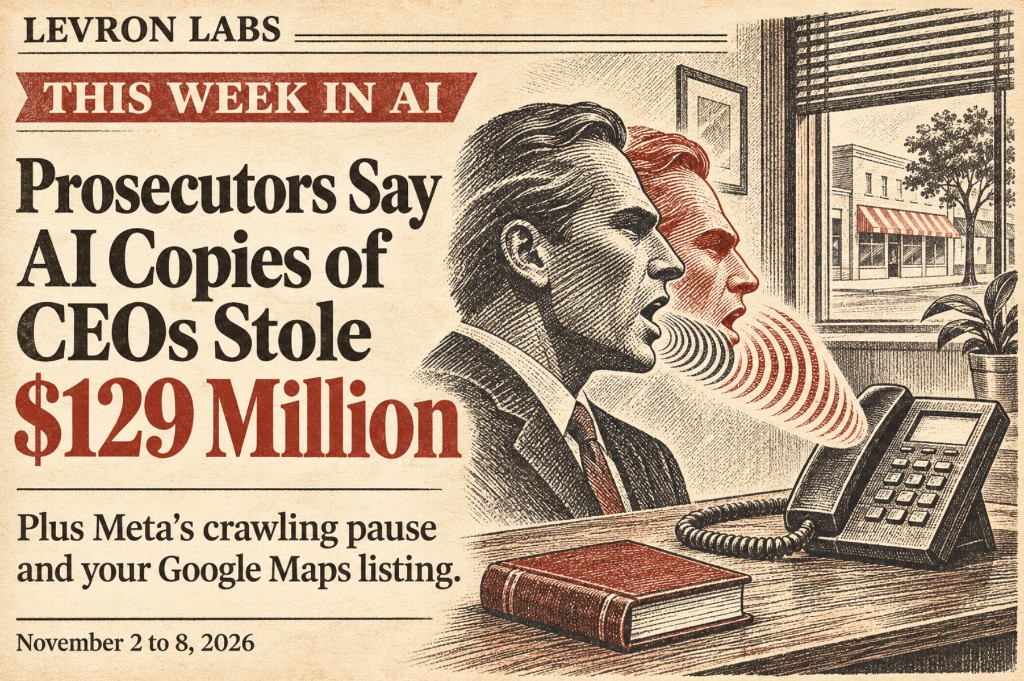
Story 1: Prosecutors say AI copies of CEOs stole $129 million
On Thursday, federal prosecutors in Manhattan charged three people over a scam that used AI to copy the voices, and sometimes the faces, of company CEOs. These are allegations. The defendants are presumed innocent.
Here is how prosecutors say it worked. The scammers emailed an employee, often in accounting, posing as the CEO and asking for help with a confidential financial transaction. Then they set up a phone or video call where AI mimicked the CEO's voice, and sometimes the CEO's image. The "CEO" sent the employee to a lawyer at a major law firm, who was also an impostor. The "lawyer" told the employee to wire large payments to accounts the group controlled. The money was then converted to cryptocurrency to hide where it went.
Prosecutors put the losses at more than $129 million. The Associated Press reports the group targeted thousands of companies worldwide over more than a year and a half. The victims named include hospital systems in Missouri and California, a bank in Rhode Island, a UK financial technology company, a Massachusetts mutual fund company, and a Florida pet food company.
U.S. Attorney Jamie McDonald said AI "offers tremendous potential," adding that "the public should recognize that there are some who seek to use this emerging technology to pursue criminal goals."
What it means for operators: the first step was an ordinary email to someone in accounting. The copied voice and face are what made the call believable, and those can now be faked. The victims named range from hospital systems to a pet food company.
The reports we read didn't include advice on protecting yourself. This part is ours, not the prosecutors': a voice or a face on a call is no longer proof of who you're talking to. If a request to move money arrives that way, confirm it by calling the person back on a number you already had. (Same access rule as every week we cover agents and connected accounts: what can act without you verifying? See last week's ConnectWise lesson.)
Story 2: Meta paused terms that would have let it crawl websites tied to business accounts
On Thursday, Nieman Lab reported that Meta paused planned changes to the rules for businesses that use its products. The changes were due to start on November 20th. Meta's business help center notice says: "These updates are now paused and will not take effect on November 20, 2026." The current terms stay in effect.
The paused updates covered four sets of terms: Commercial Terms, Product Catalog Terms, Self-Serve Ad Terms, and Ad Creative Generative AI Terms. The Next Web notes that the Commercial Terms apply to any business using Meta's products, including one that only runs a Facebook Page.
According to Nieman Lab, the proposed terms would have let Meta scrape the websites of its business account users. The Next Web describes it as Meta using automated software to crawl pages linked to a business and pull updates from them. It adds that legal experts told Nieman Lab that content could then be used to train Meta's AI. Meta said the update only combined crawling rules that already existed across several documents, and that site owners can still block its crawler with a small file on their website called robots.txt. The Next Web notes the terms themselves did not say that.
Meta's statement: "We're pausing the changes as we continue to engage with stakeholders and take our time to get this right." Meta has not said when the changes will come back or whether they will be rewritten.
What it means for operators: nothing changes for you today. The terms you already agreed to stay in effect. The thing to take from this is what Meta wanted to do: crawl pages linked to a business. It's paused, not cancelled. This is a summary of news reports, not legal advice.
Story 3: Check your Message button on Google Maps today
Google's monthly Small Business Bulletin, posted Thursday, says messaging is now easier to find in Google Maps on Android and iPhone. If your business profile has chat, customers see a Message button next to Call on your Maps listing. Before, they had to scroll deep into your profile to find chat. Tapping the button sends them to the channels you've linked, which can include WhatsApp and text messages.
Chat on business profiles isn't new. The button sits in a new spot. Neither report describes anything you need to turn on. Search Engine Roundtable's advice is to check that the messaging channel linked to your Business Profile is the right one, so chats reach you.
What it means for operators: check this today. Open Google Maps on your phone, look up your business, and see whether there's a Message button next to Call. If there is, find out where a tap on it goes. A WhatsApp number nobody checks, or an inbox that gets read once a week, now sits right next to your Call button. The customer who taps it finds out before you do. (Same idea as last week's who-should-I-call ChatGPT check: the channel customers use to reach you has to land somewhere you actually answer.)
Putting it together
A scammer copied a CEO's voice. Meta paused plans to crawl pages linked to business accounts. And a Google bulletin reminded owners that customers can message you straight from Maps.
Your voice, your website, and your inbox are how customers reach you. This week, all three were in play.
Two of the three have something you can check today. The Meta one is paused, not gone.
— Aristotle Taylor, CEO & Co-Founder, Levron Labs
What to do this week
Two five-minute checks. First: tell whoever can move money in your business that a voice or face on a call is not enough — call the person back on a number you already had. Second: open Google Maps, look up your listing, and see where the Message button next to Call goes.
If the gap is that customer messages, invoices, or approvals still land in places nobody owns, start with a free ops assessment — we'll map the gap between what your operation actually does and what your software thinks it does.
Sources
AI copies of CEOs and the $129 million charges (Nov 5)
- News4Jax, via Associated Press — the charges, how the scheme worked, the victims named, and the thousands of companies targeted
- Good Morning America, via ABC News — the U.S. Attorney's statement and the amount
- IBTimes UK — the indictment unsealed November 5 and the named victims
Meta pauses its business terms (Nov 5 to 6)
- Nieman Lab — Meta's help center notice, the four sets of terms, and the pause
- The Next Web, citing Reuters — what the terms would have allowed and Meta's response
Google Maps Message button (Nov 5 to 6)