
Key Takeaways
- 404 Media reported ChatGPT has been telling people with ordinary tech problems to email its reporters — drafting the outreach and framing routine account issues as newsworthy
- OpenAI released GPT-6.1 Terra, a mid-tier model it says costs 50% less than the version it replaces, aimed at drafting proposals, reading drawings, filling forms, and operating a computer screen
- ChatGPT can now connect to iCloud Mail and iCloud Calendar on every plan, including free, using an Apple app-specific password
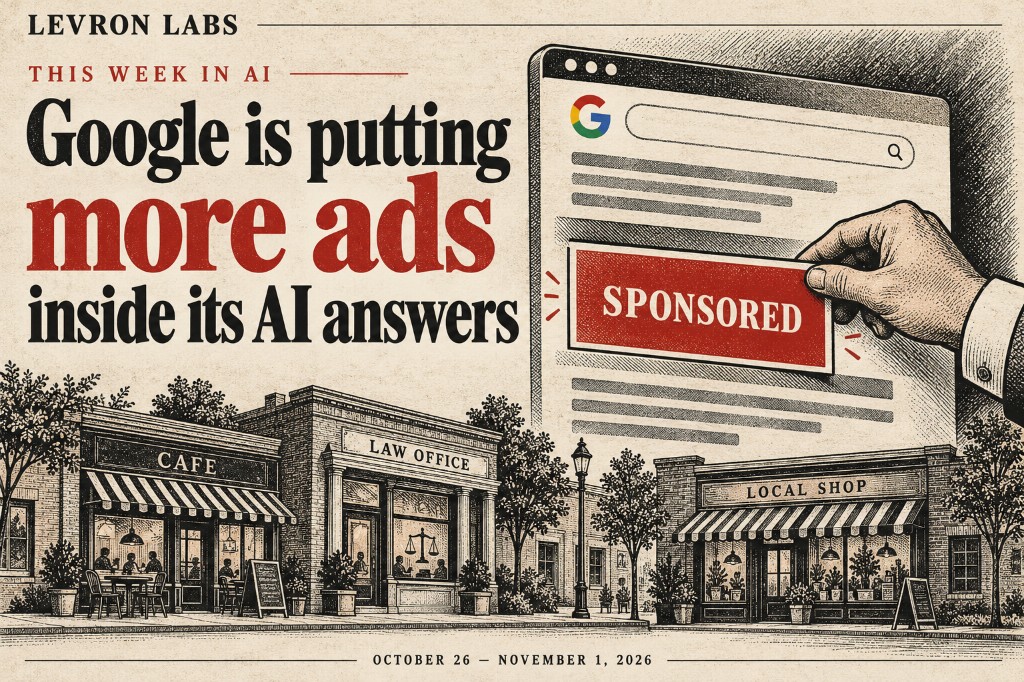
- On its earnings call, Google said it is scaling ads in AI Overviews and AI Mode; AI Mode ads are expanding to ten more countries, and Search ad growth slowed to 12% from 17%
- More customers ask an AI before they ask you — make sure your phone number, hours, and what you do are written the same way everywhere you are listed
Week of October 26 – November 1, 2026
Four things happened in AI between October 26th and November 1st that are worth five minutes of your time as someone who runs a business.
All four are about the same shift: more of your customers' questions now go to a chatbot first, and the companies behind those chatbots are deciding what to do with that.
This is Last Week in AI — the signal, not the noise. Four stories operators need to understand, and what each one means for how you run your business.
Story 1: ChatGPT kept sending people to the wrong place for help
On Monday, the tech news site 404 Media reported that ChatGPT has been telling people with ordinary tech problems to email its reporters.
In the main example, a man in Russia lost access to his Instagram account and asked ChatGPT how to get it back. ChatGPT said contacting Meta probably wouldn't work, suggested journalists instead, listed 404 Media with a reporter's email address, and wrote the email for him in English. Other people were told their routine account problems were newsworthy. One was told he had "discovered something journalistically notable." Everyone who wrote in said a chatbot had pointed them there.
404 Media's explanation is that big tech platforms offer almost no human support, so people turn to a chatbot, and the chatbot sends them somewhere. OpenAI has not said publicly why this happens.
What it means for operators: people are asking a chatbot who to call before they call anyone. When it gets the answer right, that's a referral. When it gets it wrong, the customer ends up somewhere that can't help them, with an email the chatbot already wrote. You can't control what a chatbot tells people about your business. You can make sure the right answer is easy for it to find: your phone number, your hours, and what you do, written the same way everywhere you're listed. (Same pressure as when AI knew your business existed but wouldn't recommend you.)
Story 2: OpenAI released a cheaper model built for everyday office work
Also on Monday, OpenAI released GPT-6.1 Terra, its middle-tier model. OpenAI says it costs 50% less than the version it replaces and is built for workday tasks: drafting proposals, reading technical drawings, filling out forms, and editing videos. It can also operate a computer screen, clicking and typing through a task.
OpenAI says the new model makes far fewer mistakes on prompts designed to trip it up. Those are OpenAI's own test results. No outside testing has been reported yet. It's available in ChatGPT Work, OpenAI's business plan, and to developers who build on OpenAI.
What it means for operators: for most owners, the price cut won't show up on a bill. It shows up later, in the tools built on top of it. When the engine underneath gets half as expensive, the apps that run on it — quoting tools, phone answering services, paperwork assistants — have room to get cheaper or do more for the same price. Notice the list of tasks OpenAI chose to advertise, too: proposals, drawings, forms. That's office work, not science. (Same pattern as 70,000 businesses voting against the expensive option: most operators don't need the frontier.)
Story 3: ChatGPT can now read and send your iCloud email
On Tuesday, OpenAI added iCloud Mail and iCloud Calendar to ChatGPT, for every plan, including free. It already worked with Gmail and Google Calendar.
Once connected, ChatGPT can search your inbox, summarize unread emails, draft and send replies, and create or change calendar events. It can also give you a daily summary of unread mail sorted by priority, with suggested replies. Setup takes an extra step: you create a special password in your Apple account settings just for ChatGPT, rather than using your normal one. It works on the web, on desktop, and on iPhone. Depending on your settings, ChatGPT may ask before it reads or sends anything.
What it means for operators: if your business runs on an @icloud.com or @me.com address from your iPhone, the morning inbox summary people have been getting with Gmail is now open to you, at no cost. Turning it on means a chatbot can read everything in that inbox. If you work in dental or anything else health-related, patient information should not go through a free consumer AI tool, and that includes an inbox full of it. (Same access rule as Claude Duet and the apps you connect: what is it allowed to touch without asking?)
Story 4: Google is putting more ads inside its AI answers
On Wednesday, on its quarterly earnings call, Google said it is "scaling high-quality ads within AI Overviews and AI Mode to more users and queries." AI Overviews are the AI-written summaries at the top of Google search results. AI Mode is Google's chatbot-style search.
Ads in AI Mode are coming to ten more countries, including Canada and Australia, with Brazil, Mexico, and the UK to follow this quarter. In the US, ads will also start showing up next to the follow-up questions people ask in AI Mode. Google's business chief said sponsored products in AI Mode get clicked about as often as regular results.
The reason is in Google's own numbers. Search revenue grew 12% from a year ago, down from 17% the quarter before. Google's business chief said people asking more questions in AI Mode was part of the slowdown, because "AI Mode monetized less." Alphabet's stock fell 8% after the results.
What it means for operators: Google's AI answers made it less money than its normal search results, so it is filling them with ads. If customers find you on Google, the top of the page is changing. Fewer people scroll down to a list of businesses, and more read an answer, which will increasingly have paid spots inside it. Nothing to buy today. But if you run Google Ads, ask whoever manages them whether your ads are eligible to show inside AI answers, because that is where Google is sending the attention. (This continues the ChatGPT ads story from September: the places customers ask are becoming ad platforms.)
Putting it together
A chatbot told people who to email for help. ChatGPT moved into the iPhone inbox. And Google started selling ad space inside the answers that are replacing its search results.
More of your customers are asking an AI before they ask you. Whoever controls that answer controls the referral.
None of this means you need to chase every new tool. It means the places customers ask for help are changing, and it is worth knowing what those places say about you.
— Aristotle Taylor, CEO & Co-Founder, Levron Labs
What to do this week
Open ChatGPT and ask it, "Who should I call for [your service] in [your town]?" Then ask it for your own phone number and hours. If either answer is wrong, that's what some of your customers are being told.
If the listing gaps point at a bigger visibility or ops problem, start with a free ops assessment — we'll map the gap between what your operation actually does and what your software thinks it does.
Sources
ChatGPT routing tech-support seekers to journalists (Oct 26)
GPT-6.1 Terra (Oct 26)
ChatGPT iCloud Mail and Calendar (Oct 27)
Google ads in AI Overviews and AI Mode (Oct 28–29)